All posts by : Nadine Pearce

Women’s Engineering Society Announces Top 50 Women in Engineering 2026

The Women’s Engineering Society (WES) has announced the winners of the Top 50 Women in Engineering (WE50) Awards 2026, honouring exceptional women engineers whose achievements embody this year’s theme, Engineering Intelligence. The winners were celebrated at a breakfast event at the House of Lords and the full list is available on the website https://www.wes.org.uk/we50

Now in its 11th year, the Top 50 Women in Engineering Awards are one of the UK’s most prestigious awards celebrating the contributions of women in engineering and aligned each year to International Women in Engineering Day on the 23 June. Established in 2016, the awards were created to increase the visibility of women engineers, and provide powerful role models for the next generation. Each year, the awards spotlight a different theme, reflecting the evolving landscape of engineering and the diverse ways women are shaping it.

The 2026 winners represent the full spectrum of engineering. Working across aerospace, defence, rail, manufacturing, infrastructure, energy, academia, research, technology and the public sector, they are applying technical expertise, creativity, collaboration and leadership to solve complex challenges and improve lives.

This year’s theme, Engineering Intelligence, recognises the many ways engineers combine knowledge, innovation, data, emerging technologies and human‑centred thinking to create solutions for an increasingly complex world. The winners demonstrate that intelligence in engineering extends far beyond technical capability; it includes adaptability, creativity, communication, ethical decision‑making and a commitment to delivering positive impact.

WES Chief Executive Officer Susan Robson said:

“Our theme of Engineering Intelligence for International Women in Engineering Day 2026 captures the reality of the world we’re working in today. Engineering now is shaped as much by the creativity, insight and humanity of the people who choose to be part of it as it is by technical expertise. Engineering is at its best when people are brave enough to challenge things in their quest for shared success. That spirit of courage and curiosity is what drives progress, and it’s what we’re celebrating this year.”

The winners were selected by an independent judging panel drawn from industry, academia and the wider engineering community. They were recognised for their professional achievements, technical expertise, leadership and commitment to advancing both engineering and inclusion within the sector.

The announcement forms part of the celebrations for International Women in Engineering Day (INWED), held annually on 23 June. Founded by WES in 2014, INWED has grown from a UK‑based awareness campaign into a global movement reaching millions worldwide. The 2026 theme, #TogetherWeEngineer, highlights the power of collaboration in driving innovation and building a more inclusive engineering profession.

Top 50 Women in Engineering 2026 Winners

Farah Ahmed – Secretariat International

Martina Antalova – AstraZeneca

Aaliyah Arnold – National Physical Laboratory

Sadia Bakhtiar – Loughborough University

Monalie Bandulasena – Loughborough University

Carolyn Barbour – Chivas Brothers

Nicole Beaves – Dstl

Alisha Bell – Byworth Boilers Ltd

Kamelia Boodhoo – Newcastle University

Chantal Capelletti – University of Nottingham

Rebecca Cheung – University of Edinburgh

Hoi Ching (Rachel) Chiu – Eutelsat OneWeb

Natalie Collcutt – Watkins Payne Ltd

Cristina Cortes Salas – University of Nottingham

Kathryn Davies – AtkinsRéalis

Lucy Wistow‑Hughes – BAE Systems

Jessica Day – Hillside Engineering Contractors

Deepti Deepti – University of Nottingham

Rachel Donaghey MIET – NATS

Rebecca Grant – Loughborough University

Dalia Heggo – Queen Mary University of London

Lilian Ho – AECOM

Kate Hoole‑Jackson – Malvern Panalytical

Fiona Horgan – Islington Council

Melanie Horton – AWE

Cath Hossain – Leonardo

Adrienne Houston – Eurovacuum Products Ltd

Rowshi Hussain – Cundall

Roha Javed – Arup

Xinyuan Ke – University of Bath

Leonora Lang – Arup

Alina Lixandru – AtkinsRéalis

Maryam Mehrnezhad – Royal Holloway, University of London

Kailey Mills – Stantec

Geeta Morar – Hitachi Rail

Shruti Patil – Frasers Group Plc

Beth Probert – University of Strathclyde

Amanda Reece – AtkinsRéalis UK Limited

Amna Riaz – Northumbria University

Barbara Ruffett – Assystem

Selin Shefik – Arup

Divya Shimoga Prakash – AtkinsRéalis

Maya Shinozaki – Arup

Chloe So – PulpaTronics

Nayantara Srinivasan – University of Oxford

Manuela Paulina Trejo Ramirez – University of Leicester

Iryna Tretiak – University of Bristol

Carol Verheecke Vaessen – Cranfield University

Nash Vracas – Aston Martin

Lydia Watson – 36 Engineer Regiment

Engineering and technology careers could unlock £1bn for women’s earnings

This International Women in Engineering Day (INWED), EngineeringUK has released new estimates highlighting the potential for women to increase their earnings through careers in engineering and technology.

Across the economy, women are concentrated in lower paid sectors and occupations. In contrast, roles in engineering and technology pay the equivalent of £9k a year above the average of all occupations.

EngineeringUK estimates that 240,000 people are needed to join the engineering and technology workforce each year. If 50% of these were women, there would be around £1bn more in their collective pockets every year, compared to if they went into other roles. Yet currently women make up only 17% of the UK workforce in engineering and technology.

In addition to its impact on women’s earning potential, the gender imbalance in engineering and technology inhibits the government’s ability to address workforce shortages in the sectors of greatest economic growth or to close the gender pay gap.

Hilary Leevers, Chief Executive of EngineeringUK comments: “The UK needs a thriving, diverse engineering and technology workforce to support economic growth, national security and sustainability. We need to grow both the size and diversity of the current workforce to address workforce shortages and enhance productivity and innovation. It’s vital that we have more young people, particularly young women, on education and training pathways into engineering and technology.

There would be literally millions more women in the engineering and technology workforce if they were present at the same rates as men. This would meet the country’s workforce needs and women themselves would benefit financially. The definition of a win-win.”

EngineeringUK, together with partners across the engineering and technology community, has built the Gender Pathways Collective. This partnership is driving a collective mission to significantly increase the number of girls and young women in education pathways to engineering and technology by the age of 18.

This INWED, EngineeringUK is calling for action to tackle the gender imbalance in engineering and technology. We are:

  • seeking to engage the Secretary of State for Education and the Minister for Women and Equalities with the work of the Gender Pathways Collective
  • working with the Gender Pathways Collective on a blueprint for action for government, for launch this in September

For more information about the Gender Pathways Collective and our work to inspire more women into engineering and tech, go to Gender pathways into engineering and technology

SALERNO HOSTS SIGNING OF LANDMARK AGREEMENT BETWEEN CERTING AND THE UK ENGINEERING COUNCIL

Salerno, Italy – CERTING and the Engineering Council (UK) today formally signed a new Admissions Pathways Agreement designed to strengthen professional mobility and collaboration between the engineering professions in Italy and the United Kingdom.

The agreement establishes streamlined pathways for engineers who hold recognised professional registration or certification in either country to apply for equivalent recognition in the other jurisdiction. By reducing duplication in assessment processes while maintaining rigorous professional standards, the agreement will make it easier for experienced engineers to demonstrate their competence and pursue professional opportunities internationally.

The agreement applies to engineers holding CERTING Advanced certification in Italy and Chartered Engineer (CEng) registration in the United Kingdom. It reflects the shared commitment of both organisations to recognising professional competence, supporting lifelong professional development, and promoting excellence in engineering practice.

Speaking at the signing ceremony in Salerno, Ing. Tiziana Petrillo of CERTING, and Paul Bailey, CEO of the Engineering Council, emphasised the importance of international cooperation in addressing global engineering challenges and supporting the mobility of highly skilled professionals. The agreement recognises the strong alignment between the competence-based assessment systems operated by CERTING and the Engineering Council, while respecting the regulatory and professional requirements of each jurisdiction.

Under the new framework, applicants will benefit from a more efficient recognition process that minimises unnecessary reassessment, acknowledges existing professional achievements, and maintains public confidence in professional registration and certification decisions. The agreement also provides mechanisms for cooperation on professional standards, information exchange, continuing professional development, and disciplinary matters.

CERTING, established by the Consiglio Nazionale degli Ingegneri (CNI), is Italy’s leading engineering competence certification body. The Engineering Council, incorporated by Royal Charter, regulates the engineering profession in the United Kingdom and licenses professional engineering institutions to award Chartered Engineer registration.

The signing of the agreement marks a significant milestone in strengthening professional ties between Italy and the United Kingdom and demonstrates the commitment of both organisations to supporting engineers in an increasingly international profession.

About CERTING

CERTING is the certification body established by the Consiglio Nazionale degli Ingegneri (CNI) to certify the professional competence of engineers in Italy. Operating under accredited certification standards, CERTING promotes excellence, professional development, and the recognition of engineering competence across a broad range of disciplines.

About the Engineering Council

The Engineering Council is the United Kingdom’s regulatory body for the engineering profession. Incorporated by Royal Charter, it sets and maintains internationally recognised standards of professional competence and commitment and holds the national registers of professionally registered engineers and technicians.

Renowned Engineer and Broadcaster Dr Lucy Rogers MBE FREng FIMechE HonFIED Elected Next Honorary President of the Institution of Engineering Designers

Former Robot Wars judge and champion of public engineering engagement steps into prestigious leadership role to inspire the next generation of product, engineering, and CAD designers.

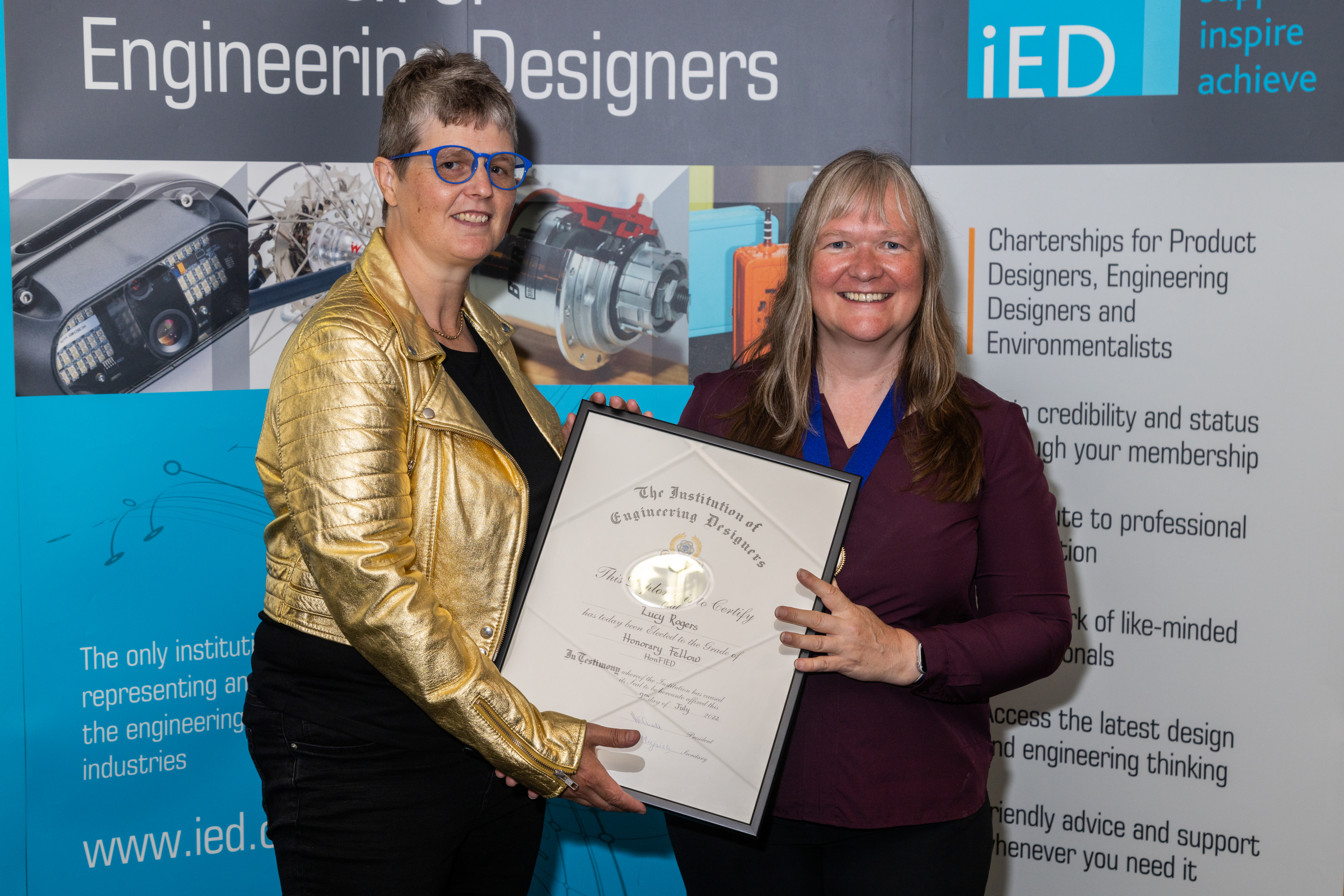
WESTBURY, UKJune 8, 2026 – The  Institution of Engineering Designers has officially announced the election of Dr Lucy Rogers MBE FREng as its next Honorary President. Dr Rogers, a highly distinguished Chartered engineer, author, inventor, and communicator will succeed the outgoing Honorary President Mandy Chessell, to lead the institution’s ongoing mission of advancing education and professional excellence in engineering and product design.

Already an Honorary Fellow of the IED (awarded in 2022), Dr Rogers brings decades of multi-disciplinary engineering expertise, ranging from analysing space debris mitigation strategies to solving complex animatronic challenges for theme parks. Notably awarded an MBE in 2024 for services to engineering, she is globally celebrated for her ability to translate dense, highly technical scientific concepts into accessible “plain English” for mainstream audiences. As Honorary President, she will champion the value of professional registration, diversity in STEM disciplines, and the vital role that creative design engineering plays in solving real-world, global challenges.

“I am honoured to become Honorary President of the Institution of Engineering Designers. The IED reflects the kind of engineering I care about: creative, practical, rigorous, welcoming to people who arrive by different routes, and full of possibility and fun. I am delighted to support its work championing engineering design.” Dr Lucy Rogers MBE FREng, Incoming Honorary President

The IED is the UK’s premier professional body representing individuals working across engineering design, product design, and computer-aided design (CAD). Under Dr Rogers’ presidency, the IED plans to ramp up its public engagement initiatives, expand support networks for early-career design engineers, and emphasise sustainable practices in engineering design frameworks.

“We are absolutely thrilled to welcome Dr Lucy Rogers as our new Honorary President. Lucy’s remarkable track record as a Fellow of the Royal Academy of Engineering, combined with her unparalleled passion for public communication, makes her the perfect ambassador for the IED. Her leadership will undoubtedly inspire our current members and attract the next generation of creative design talent to our industry.”

— Libby Meyrick, CEO at the Institution of Engineering Designers

Dr Rogers will officially commence her tenure at the upcoming IED Annual General Meeting, where she will deliver her inaugural presidential address outlining her core vision for the institution.

###

Media Contact Information

  • Company Name: Institution of Engineering Designers (IED)
  • Email Address: ied@ied.org.uk
  • Phone Number: +44 1373822801
  • Website: ied.org.uk

About Dr Lucy Rogers MBE FREng

Lucy is the author of: Up: A Scientist’s Guide to the Magic Above Us and It’s ONLY Rocket Science. She was a judge on BBC Robot Wars, has hosted engineering and technology podcasts, and founded the Guild of Makers, a community supporting practical creativity, engineering and making. She was also an Erskine Fellow at the University of Canterbury in New Zealand, where she worked with students and colleagues across product design, engineering, science and public engagement.

Her work often sits at the boundary between disciplines, helping people understand how engineering thinking, creativity and practical problem-solving shape the world around us. She was awarded an MBE for services to engineering and is recognised for her innovative engineering work, her contribution to public engagement, inclusive routes into STEM, and the communication of complex technical ideas in clear and imaginative ways.

About the Institution of Engineering Designers (IED)

Established in 1945 to support and validate excellence in design, the Institution of Engineering Designers (IED) is the UK’s only professional body dedicated strictly to engineering and product designers. The IED qualifies its members for professional registration as Chartered Engineers (CEng), Incorporated Engineers (IEng), Engineering Technicians (EngTech), Chartered Technological Product Designers (CTPD), Registered Product Designers (RProdDes), Chartered Environmentalists (CEnv), Registered CAD Managers (RCADMan) and Registered CAD Practitioners (RCP)