All posts by : Admin

2026 QEPrize Create the Trophy Competition is now open!

The Queen Elizabeth Prize for Engineering is a global prize that celebrates the successes of modern engineering. With QEPrize winners selected from across the world, such an international prize requires a truly international trophy.

Every year, the Queen Elizabeth Prize for Engineering trophy is found through the ‘Create the Trophy’ competition. The competition gives young people aged 14-24 the opportunity to get involved, testing their design skills using the latest in 3D-design technology. The winner receives a high-end laptop, a 3D printed model of their trophy, and the opportunity to see their 3D printed winning design presented to the winners of the Queen Elizabeth Prize for Engineering in London, UK. In addition, the winning trophy will also go on display in the Engineers gallery at the Science Museum, which showcases engineering innovations through the lens of the QEPrize.

The 2026 Create the Trophy competition is now open and closes at 23.59 (UTC) on Friday 28 November, and the winner will be announced on 3 February 2026.

Trophy designs are created and submitted using the QEPrize 3D Design Studio app, which is
free to download on both iOS and Android. To find out more, visit the website: www.qeprize.org/trophy


Applications are now open for the MacRobert Award, the UK’s premier award for engineering innovation

The MacRobert Award is the UK’s longest-running and most prestigious national prize for engineering innovation.

For over 55 years, the MacRobert Award honours the very best of UK engineering which demonstrates outstanding innovation, commerciality and societal benefit.

Originally founded by the MacRobert Trust, the Award is now presented and run by the Royal Academy of Engineering, with support from the Worshipful Company of Engineers.

Winners receive a £50,000 cash prize and the iconic MacRobert gold medal, together with national recognition, extensive media coverage, and an exclusive celebratory weekend at Douneside House on the MacRobert estate in the heart of Aberdeenshire.

Applications are welcomed for innovations across all areas of engineering, applied science, technology and medicine — from ambitious start-ups to established industry leaders. Deadline for applications is 5pm on 31 January 2026.

Further information can be found here

Event by SocEnv – Registration 101: REnvP Q&A

Join us on the 16th to get your REnvP questions answered

This drop-in session is an informal chance to quiz our team about your next steps towards your Registered Environmental Practitioner (REnvP) goal. Think of it as a coffee break with a splash of career development.

Have a think about your REnvP plans. Did you stumble across some questions? Here’s the time to ask. Register for free using the very simple form and join us on the day via Microsoft Teams. Your questions come with zero obligation to apply for REnvP, but the planet might thank you.

Join us at any time between 8.30am – 9.30am BST on the 16th October 2025 from anywhere in the world.

These Q&A drop-in sessions are mainly designed for those at the early stages of application or those thinking about it. Having said that, we’ll try to help with all questions and signpost to valuable resources or to another contact.

See you then.

REGISTER HERE

Engineering Design in Medical Devices Webinar – How Well Do You Know Your User?

Understanding the user is at the heart of safe, effective, and innovative medical device design. This webinar explores how engineering teams can integrate diverse user perspectives, translate the Voice of the User into measurable design inputs, and balance innovation with regulatory compliance.

Through guided discussion and Q&A, we’ll look at practical strategies for managing technical feasibility, risk, and user needs throughout the design process—right through to post-market surveillance and feedback integration.

Join us to gain insights into how user-focused design can lead to better outcomes for patients, clinicians, and the broader healthcare system.

This webinar is being held on 29 October 2025 from 18.00 – 19.30.

Click here to register

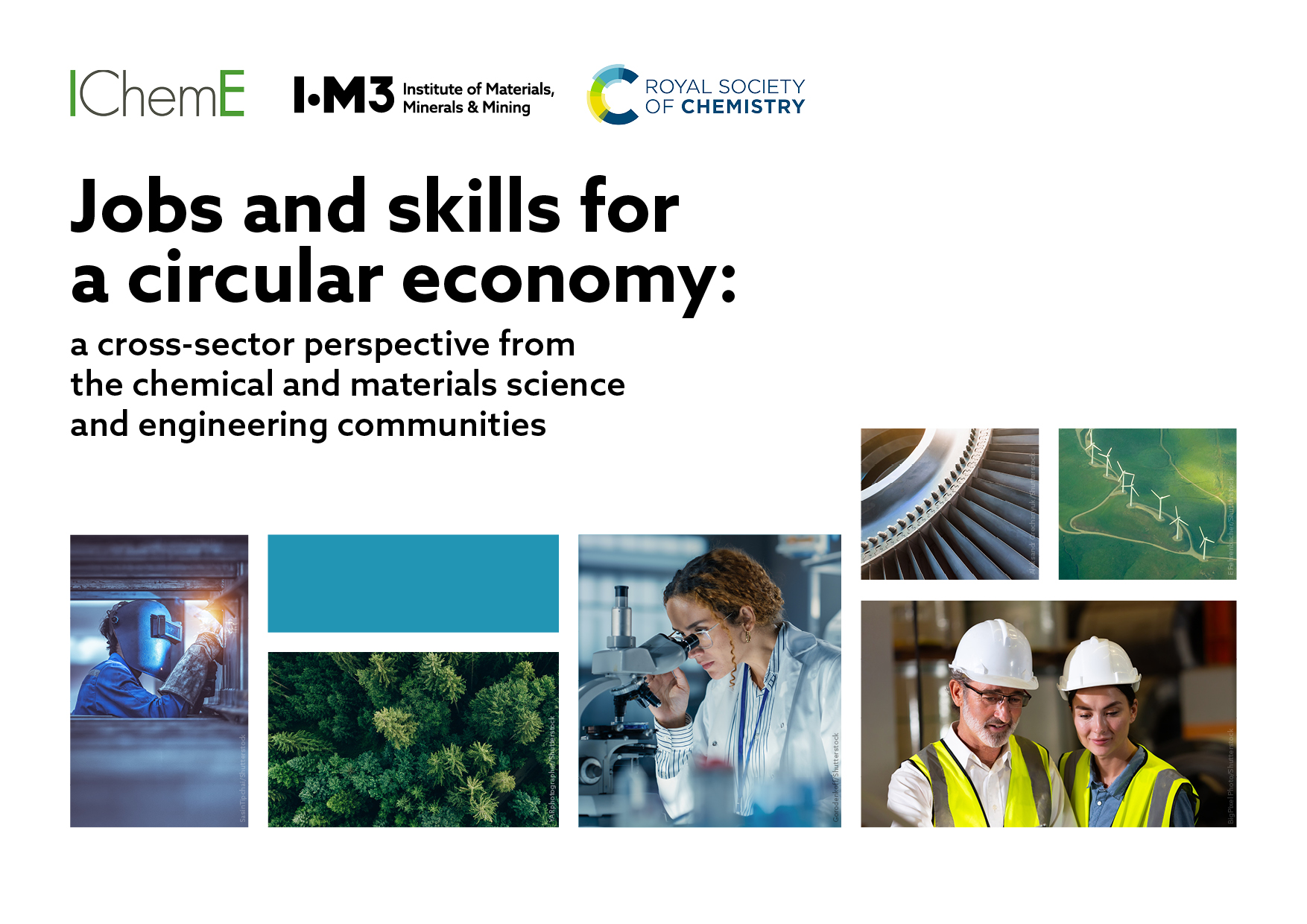
IOM3 publishes joint report with IChemE and RSC on skills shortage

The new report identifies skills shortages that hinder circular economy progress in the UK.

The Institute of Materials, Mineral & Mining (IOM3), has come together with the Institution of Chemical Engineers (IChemE) and the Royal Society of Chemistry (RSC) to publish a report highlighting the skills gaps and challenges that the UK faces in developing the workforce required to deliver a successful circular economy, as well as setting out steps to address those challenges. 

This report draws on insights from across industry, academia, education and training providers and policymakers, and calls for recognition of the fundamental role chemical and materials science and engineering play in realising the opportunities offered by greater circularity, including securing growth and building supply chain resilience. 

Rachel Stonehouse, Head of Policy at IOM3, said, ‘This report is informed by a broad and diverse community across our disciplines. It brings together insight from a range of actors and different sectors and clearly demonstrates that delivering the workforce to drive the circular transition is a cross-economy priority and pressing risk facing the UK.

‘Essential for the UK’s long-term economic and environmental resilience, the shift to a low-carbon, circular economy relies fundamentally on chemical and materials science and engineering. As professional bodies, we will continue to support our communities to lead the transition and to help build the partnerships needed to deliver the skilled, inclusive and adaptable circular economy workforce the UK urgently requires.’

The Department for Environment, Food and Rural Affairs said: ‘This government is committed to building a circular economy where we keep resources in use for longer and reduce waste. This transition will accelerate our path to net-zero, drive vital investment in green infrastructure and jobs, boost our economy and help nature flourish. Getting our workforce equipped with the right skills will be absolutely critical to making this transformation a success.’

The UK consumes 15.3 tonnes of materials per person each year – roughly double what is considered sustainable – with over 90% of those materials lost to the economy at the end-of-life. Transitioning away from this linear approach to materials consumption to a circular economy is a pressing imperative, but this can only be achieved with the right jobs and skills.

The report highlights the need for long-term policy certainty and stability to support industry investment and individual career choices. It also calls for better awareness of job opportunities, stronger support for the skills pipeline by tackling barriers to education and increasing workforce diversity, an effective approach to regulation, planning and permitting and greater alignment between government strategies.

Jobs and skills for a circular economy: a cross-sector perspective from the chemical and materials science and engineering communities is based on insights from two online workshops with 47 expert stakeholders across industry, academia, education and training providers and policymakers, and a survey with 54 participants.

Read the full report here

UK Young Engineer of the Year crowned

  • The winners of The Big Bang Competition have been announced today, including the new UK Young Engineer and UK Young Technologist of the Year, supported by Siemens
  • Young people’s winning projects include an automatic pill dispenser and an alternative telecommunications system for emergency communications in rural areas

The winners of The Big Bang UK Young Scientists & Engineers Competition have been announced today, including the top awards of the UK Young Engineer and UK Young Technologist of the Year, supported by Siemens. Held at The Big Bang Fair, the awards ceremony followed a day-long showcase of impressive young talent.

The Big Bang Competition, run by charity EngineeringUK, is a nationwide competition for young engineers, scientists and technologists aged 11 to 18, which recognises and rewards talented young innovators. There are a range of awards and prizes up for grabs, with the top 3 winners each receiving £1,000 prize money.

UK Young Engineer of the Year 2025

Aaron Lord, a year 12 student from Greenhead College in Yorkshire, has been crowned UK Young Engineer of the Year for his project ‘Autopill’. Inspired to support those taking regular medication, particularly people with dementia and memory difficulties, Aaron created an automatic pill dispenser. Using mechanics, electronics and computer-aided design (CAD), the ‘Autopill’ allows users to insert their pills for the week and includes a pulsing light and bleeping noise to signal that pills are ready to take. The impressive device also includes a health monitoring component which can track users’ heart rate and oximetry when placing their finger on a sensor.

Aaron commented “I’m thrilled to accept this award – it’s incredible! The Competition has been a brilliant experience from start to finish. It allowed me to take something that I thought was a good idea and turn it into something tangible.”  

Engineering Award winners

Gayatri Thiru, year 8 at Invicta Grammar School, Kent, is the Junior Engineering winner for their design for a solar powered, remote-controlled machine that harnesses nanotechnology to clean oil spills in the ocean. It uses magnetite nanoparticles, which are tiny particles that attract oil and repel water. Once these particles soak up the oil, magnetic fields will be used to pull them back out of the water for recovery.  

Om Kuravinakop, from St Olave’s and St Saviour’s Grammar School in London, is the Intermediate Engineering winner. Om, year 11, created a hand-held air quality monitor for asthma patients that tracks fine particulate matter, ozone, nitrogen dioxide and humidity. It also syncs to a smartphone to help people with asthma monitor risk levels with a view to preventing attacks.  

Grace Palmer, in year 12 at WMG Academy for Young Engineers Solihull, is the Senior Engineering winner for her project ‘Thrive transfer aid’. Inspired by the challenges faced by her young cousin, Grace wanted to find ways to improve the lives of disabled children and their families. She has created a new product to help transfer children comfortably whether that’s from bed to a desk chair or from a wheelchair to a rollercoaster. Providing a more affordable and inclusive solution, the aid also allows young children to be comfortably carried and enables them to sit at a restaurant table.

UK Young Technologist of the Year 2025

The UK Young Technologist of the Year, supported by Siemens, has been named as Muhammad Shah, a year 13 student from Queen Elizabeth’s School Barnet in London, for their project ‘Icarus’. Inspired by his love of the outdoors and trekking, Muhammad created an alternative telecommunications system for low-cost and effective emergency communications in remote areas.

Mark Wood, Social Sustainability Lead at Siemens GB&I, commented, “Congratulations to The Big Bang UK Young Technologist of the Year, supported by Siemens! This year the competition was intense, but Muhammad stood out with his decentralised communication system which avoids reliance on cellular or satellite networks, and has great opportunities for search and rescue, leisure and other business uses. Muhammad demonstrated independent learning and great communication and presentation skills and is a worthy winner of the prize!

“The Big Bang Competition is a great opportunity to demonstrate ingenuity and creativity within technology and how technology is essential across business and our lives, including to support digitalisation and sustainability.”

Muhammad, who was unable to attend the awards ceremony due to A level exams, is due to be presented the award later this month at his school’s design showcase.

Dr Hilary Leevers, EngineeringUK Chief Executive, said “Huge congratulations to all our winners, who have shown impressive creativity, knowledge and drive as they have worked on their projects. I hope they, and all the runners-up, are proud of their achievement. There are so many opportunities for them to continue with STEM in education and training and then in the workplace. I’m sure they have a bright future ahead.”

UK Young Scientist of the Year 2025 and other winners

Alice Morrish, a year 10 student from Invicta Grammar School in Kent, was crowned UK Young Scientist of the Year for their project ‘Quantum Karate’. Other winning projects across the competition included an AI-based programme for cancer diagnosis, a menopause cooling stick and a facemask that converts pollutants.

To find out more and discover all the winners of The Big Bang Competition 2025 visit: www.thebigbang.org.uk/competition-winners

To find out more about The Big Bang Fair, which is running at Birmingham’s NEC from 17 June to 19 June 2025, visit: www.thebigbang.org.uk/the-big-bang-fair/

EngineeringUK releases updated workforce data

New workforce data released today by EngineeringUK reveals there are 6.4m people employed in engineering and technology roles in the UK.

Key workforce data:

  • There are approximately 6.4m people working in engineering and technology occupations in the UK – around a fifth of the workforce (19.3%)
  • Women remain significantly underrepresented in engineering and technology. Only 16.9% of the workforce are women, compared to 56% of other occupations
  • UK minority ethnic groups are also underrepresented, making up 14% of the workforce, compared to 18% of other occupations
  • Disabled people make up 14% of the engineering and technology workforce, lower than the 19% across all other occupations

EngineeringUK Head of Research, Becca Gooch said, “The latest data shows that there is still more to be done before we have the diverse workforce we need for UK engineering and technology to thrive. Women remain the most underrepresented group. Back in 2010, women made up around 10% of the workforce, so 16.9% is certainly an increase, but over 15 years, this is slow progress for a sector growing faster than any other between now and 2030.

“Our research shows introducing young people to what a career in engineering and technology could mean for them ignites a passion for STEM among young people from all backgrounds. STEM outreach programmes like The Big BangEnergy Quest and Climate School Programme help bring to life real-world engineering and tech careers for young people. But we’d like the sector, which has a skills and labour shortage, to do much, much more to recruit and retain talented women.”

EngineeringUK has partnered with the Royal Academy of Engineering, Women’s Engineering Society (WES), BCS, the Chartered Institute for IT, and Women into Science and Engineering (WISE) to address the underrepresentation of women. Together we will drive a collective mission to increase the number of girls in education pathways to engineering and technology at 18, focusing on key areas influencing girls and young women’s engineering and technology career choices. Read more about this work online at www.engineeringuk.com/genderpathways.

The latest briefing with the updated engineering and technology workforce data and analysis is available on the EngineeringUK website at www.engineeringuk.com/workforce.

Volunteers Week – Celebrating the volunteers who help shape our profession

This Volunteers’ Week (2-8 June 2025), the Engineering Council celebrates the dedicated individuals whose time, expertise and passion help uphold the standards that maintain the trust and respect of the engineering profession.

A national campaign that takes place every June, Volunteers’ Week celebrates and thanks volunteers for the important work they do. It is an opportunity for organisations and communities to show their appreciation for both current and past volunteers.

The contributions of our volunteers help uphold the Standards that define the engineering profession. From our Board of Trustees, who guide the strategic direction of our organisation, to those who contribute their expertise through panels, committees, and working groups, our volunteers are at the heart of everything we do at the Engineering Council. They help develop and maintain the Standards and Guidance that underpin professional registration, support the quality assurance of our licensed professional institutions, and provide essential insight from across industry, academia, and beyond.

Engineering Council CEO, Paul Bailey says “With a regulatory regime based on peer review, the expertise and commitment of our volunteers are vital to the work of the Engineering Council. We remain sincerely grateful for all of our volunteers’ time and dedication, without which we would not be able to support and develop the high standards that give the engineering profession its credibility and public trust”.

As we thank all our volunteers for their ongoing support, we also encourage others to get involved. Volunteering is a chance to give back, grow professionally, and help shape the future of engineering.

For more information on volunteering with us, email governance@engc.org.uk.

Engineering Council officially launches new UK-SPEC HRB Standard

The official launch of a new Standard for building safety has been held recently at the House of Lords at an event hosted by his Lordship the Earl of Lindsay. IED Trustees, Simon Vaitkevicius and Neil Phelps, attended the launch in their roles as Group B representatives on the EC Board.

The new UK Standard for Professional Engineering Competence and Commitment contextualised for Higher-Risk Buildings (UK-SPEC HRB) has been developed by the Engineering Council in response to recommendations made in Dame Judith Hackitt’s independent review of building regulations and fire safety, ‘Building a Safer Future’, which was commissioned by the UK Government in the aftermath of the tragic Grenfell Tower Fire in 2017.

UK-SPEC HRB was developed, in collaboration with professional engineering institutions and expert volunteers, to assess the competence and commitment of individual engineers and technicians working on higher-risk buildings in the UK. Based on the UK Standard for Professional Engineering Competence and Commitment (UK-SPEC) the new Standard is tailored for engineers and technicians working in the built environment, particularly on the design, construction, maintenance, and operation of higher-risk buildings.

It incorporates the criteria from BS 8670 and sets out a sector-specific competence framework consisting of a core document and Discipline Annexes. Demonstrating competence could involve registration against the core framework only, or a combination of the Discipline Annexes: Fire Engineering, Structural Engineering, Building Services Engineering and Facade Engineering.

As the keynote speaker, Dame Judith highlighted why it is important to have assured competence of those working on higher-risk buildings and that this must be centred on professionalism: “people who will uphold high standards of professional conduct themselves and call out those who undermine that in any way”. Dame Judith also emphasised that this launch is very much the end of the beginning of the process. The real work now is for engineering institutions to promote the new Standard with their members and strongly encourage people to go through the process. She stressed that wider industry must be informed about the new Standard and the benefits of being able to prove that buildings have been designed and constructed by demonstrably competent people.

A welcome and overview of the importance of regulation was given by Lord Lindsay, Chair of the UK Accreditation Service (UKAS), followed by an address by Prof John Chudley, Chair of the Engineering Council in which he described UK-SPEC HRB as a framework that reinforces professional accountability with public safety at its core. A speech was also delivered by Sandra Ashcroft on behalf of the Building Safety Regulator, who welcomed the new Standards as an invaluable tool for identifying and engaging truly competent professionals who can meet the stringent safety requirements of HRBs.

Trustees and staff from the Engineering Council were pleased to join with representatives from the professional engineering community to celebrate this milestone in working towards improved public safety.

Engineering Council CEO, Paul Bailey, said: “We are very proud to be launching this new Standard today which presents a significant milestone in our continuing work with the professional engineering community to ensure public safety in the built environment. We hope the tragedy of the Grenfell Tower fire and the sad loss of 72 lives will never be seen again. UK-SPEC HRB will provide a means for those engineers and technicians working in the built environment, particularly on the design, construction, maintenance, and operation of higher-risk buildings, to become professionally registered. This is the first step however and it is our hope that UK-SPEC HRB is embraced and championed by the sector and the wider engineering profession, and that the Standard, and the Register of those individuals assessed against it, will support the continuing improvement of public safety across the sector”.

CEO of the Chartered Association of Building Engineers (CABE), Richard Harral, said: “The launch of this new registration scheme for engineers working on HRBs represents a step change through career competence management. By providing a tailored approach to assessing competence for all major roles within design and project teams, from technician to Chartered Engineer, the HRB Register will incentivise investment in the lifelong learning necessary to ensure engineers are competent and that buildings remain safe throughout their life.”

The Institution of Fire Engineers (IFE) CEO, Steve Hamm, said: “The IFE is proud to support the launch of the Fire Discipline Annex to the UK-SPEC HRB. This marks a significant milestone in maintaining the highest standards of professional competence within the built environment, reflecting the growing complexity and scrutiny associated with higher-risk buildings. Fire engineering plays a crucial role across all sectors, and this annex offers a clear framework for practitioners to demonstrate their capability in line with the Building Safety Act. As the professional engineering institution licensed to assess against this Standard, we remain committed to upholding public safety and promoting excellence across the profession, working alongside the Engineering Council and other institutions to contribute to safer, better-managed buildings.”

Ruth Carter, CEO of the Chartered Institution of Building Services Engineers (CIBSE), commented: “CIBSE fully supports the launch of the UK-SPEC HRB as a vital step in strengthening competence across higher-risk buildings. This Standard sets out clear, essential safety criteria – covering fire, structural integrity and public health – helping to ensure engineers are equipped to meet the highest professional standards. We look forward to working with the Engineering Council and fellow institutions to raise awareness and drive uptake of HRB registration across the sector.”

Séan Harris, Institution of Civil Engineers (ICE) Deputy Director General and Director of Membership, said: “The Grenfell Tower tragedy reinforced the infrastructure sector’s role in understanding and managing safety risks. Earlier this year, the Institution of Civil Engineer and the Institution of Structural Engineers launched the registration process for the Higher-Risk Buildings Register, which is owned by the Engineering Council as part of the new UK-SPEC HRB. The ICE is proud to be working with partners like IStructE and the Engineering Council to manage this essential register, which will increase transparency of the design and maintenance of higher-risk buildings. This is positive progress, but there’s no room for complacency. As an institution we are committed to delivering lifelong learning and ensuring there are competent professionals to deliver the work society needs.”

Yasmin Becker, CEO of the Institution of Structural Engineers (IStructE) said: “Professional competence and high standards are essential for structural safety, and therefore the UK-SPEC HRB is an important Standard which we wholeheartedly support. It clarifies the competences and the commitments of engineering professionals working on higher-risk buildings (HRBs). We are pleased to have worked with the Engineering Council and Institution of Civil Engineers (ICE) in the development of this Standard and a new competency Register for professionally qualified structural and civil engineers who wish to demonstrate their competence in working on HRBs. We look forward to working with the Engineering Council and ICE to develop the Register and support clients and the wider public to identify competent professionals in this critical specialism.”

With the Government’s commitment to building 1.5 million homes over this Parliament which are of high quality, and safe now and in the future, we believe our HRB Register and UK-SPEC HRB is a key example of how this ambition can be achieved through a pipeline of suitably qualified professionals for the housing and construction market with the right skills. We welcome the professional engineers who have already achieved registration, and we are committed to building on this momentum.

Please click here to view or download the UK-SPEC HRB.

Nominations for the 2026 QEPrize are now open!

The QEPrize seeks nominations from the public that celebrate a wide variety of engineering innovations across all sectors of the profession, and a breadth of nominators from all corners of the globe.

The £500,000 prize is the world’s most prestigious engineering accolade, awarded to up to 10 engineers responsible for a bold, groundbreaking engineering innovation of global benefit to humanity.

Since 2013 we have honoured 33 eminent engineers whose innovations have affected billions of lives. Again, this year, we are seeking a diverse range of nominations that truly epitomise excellence in engineering.

The QEPrize is an international award and accepts nominations from anywhere in the world. The only limitations are that self-nomination and posthumous nomination are not allowed.

The nominations portal for the 2026 QEPrize are now open, and will close on 27 June. Please click here to access the portal.

Nominations Checklist

  • Does the innovation have global impact?
  • Can you identify up to 10 engineers responsible?
  • Do you have enough information to write a case for nomination?
  • Are you able to identify at least 3 people who are familiar enough with the innovation to act as referees?

Please click here to view an example nomination.